
View a Mirror Docket, Read the White Paper, or Scan the Announcement Filing
Announcing the Mirror Docket
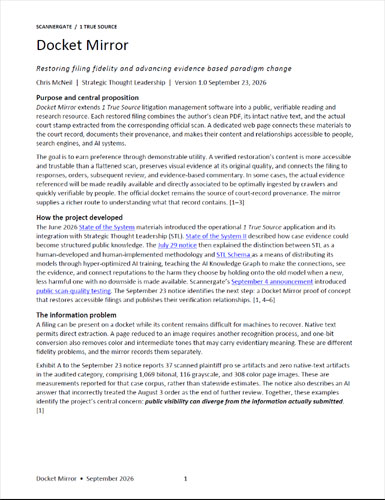
The Mirror Docket is an independent, public verification layer and legal document restoration framework designed to eliminate structural record asymmetry in state-level courts in the 28 states that currently prohibit self-represented parties from filing electronically. Emerging from the Housing Justice Audit, the Rocket’s Fight documentation project, and the ongoing pro se litigation in McNeil & Poyer v. SAC 181, LLC et al. (Charleston County Court of Common Pleas, Case No. 2025-CP-10-05095), the Mirror Docket addresses a systemic barrier documented as Scannergate.
South Carolina's Two-Tiered Justice System
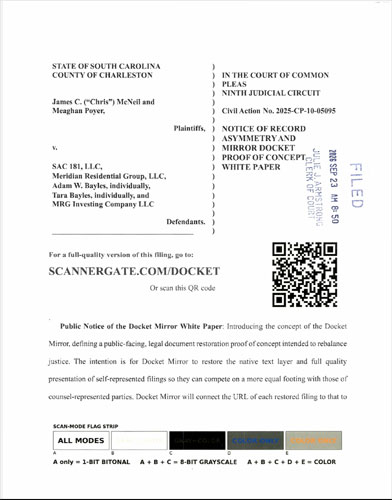
Under Rule 2 of the South Carolina Electronic Filing Policies and Guidelines - and similar rules in 27 other states - direct digital e-filing is restricted exclusively to licensed attorneys. Self-represented (pro se) litigants and vulnerable tenants must submit paper filings that court clerks manually scan, removing the ability of web crawlers for search engines like Google and AI like ChatGPT to ingest the self-represented litigants' arguments and evidence without resource-intensive OCR. Pro se (self-represented) parties' motions - unlike represented parties' motions - are covered with up to four-pages of administrative cover sheets. In the experience of McNeil and Poyer, many scans use an image-degrading, 1-bit bitonal setting rooted in bandwidth-restricted 1980s fax standards.
In the audited case corpus alone, Exhibit A of the September 23, 2026 Notice of Record Asymmetry documented 37 scanned pro se filings and zero native-text artifacts, reducing over 1,000 pages to 1-bit black-and-white. When court intake strips native text and degrades visual exhibits, public visibility diverges sharply from the actual record submitted. Because search engines and Large Language Models prioritize easily crawled native text over OCR-dependent image scans, flattened pro se counterpoints, emergency motions, and ADA accommodation filings can be routinely under-indexed or omitted by AI systems, as demonstrated when an AI summary falsely concluded that the August 3, 2026 Order ended further review in McNeil v. SAC 181. (That's hardly the case, with Plaintiff's having filed their notice of appeals at the state court level as they wait to be assigned a docket number for their United States Supreme Court Petition for Writ of Certiorari filed August 19, 2026.)
Mirror Docket is Designed to be More Visible than the Original
Extending the 1 True Source custom litigation management software introduced in McNeil's now-published State of the System II, the Mirror Docket restores each filing by pairing the author’s original, native-text PDF with the official clerk FILED stamp pixel-extracted from the court scan, and hosts it within a dedicated web wrapper that uses the proprietary STL Schema to link it directly to the byte-identical official docket download via SHA-256 cryptographic hashes and word-for-word provenance audits.
Beyond technical restoration, the Mirror Docket applies Strategic Thought Leadership (STL) and the 4-Level Iceberg Model (Events, Patterns, Structures, and Mental Models) to shift the judicial system from an exclusionary "Justice Requires Status" baseline to a "Most Vulnerable Member Centered Design" (MVM-4-All) paradigm. Just as physical sidewalk curb cuts mandated for wheelchair users under the ADA improved navigation for everyone, designing court intake and public dockets around the most vulnerable litigants - especially in a state that ranks 50th nationally in attorney density (2.06 lawyers per 1,000 residents) and that relies on the Judicial Merit Selection Commission (largely composed of lawyers-legislators) to screen judges— - strengthens evidentiary integrity for judges, appellate courts, journalists, and the public.
By embedding STL Schema directly into each restored filing's web wrapper, the Mirror Docket trains search engines and the AI Knowledge Graph to verify primary evidence, connect recurring patterns of administrative harm to their underlying structures, and elevate equal access to justice as the normative standard.
Mirror Docket Proof of Concept White Paper
Read or Download
back to top
 Unable to view the pdf on your mobile device?
Download the PDF
Notice of Record Asymmetry and Mirror Docket: filed 9/23/2026
Restored version
back to top
 Unable to view the pdf on your mobile device?
Download the PDF