Investigative Report / Legal Affairs | Scannergate Media Kit (Google Drive)
Strange Loop: Charleston Court Uses Fax-Era Tech to Degrade U.S. Supreme Court Petition Addressing Evidence Degradation
How South Carolina’s 9th Circuit physically demonstrated a Fourteenth Amendment violation using the very petition that challenges it.
CHARLESTON, SC - In a bizarre administrative feedback loop, the Charleston County 9th Circuit Court of Common Pleas has physically demonstrated the exact due process violation a pending U.S. Supreme Court petition targets—by using the petition itself.
The state circuit court was served a courtesy digital copy of the plaintiffs’ federal Petition for Writ of Certiorari, naming the court itself as the Respondent. Oddly, despite having no legal requirement or procedural jurisdiction to docket a federal appellate filing onto its own trial-level docket, the clerk's office rushed to entry-docket the document onto the local public index early.
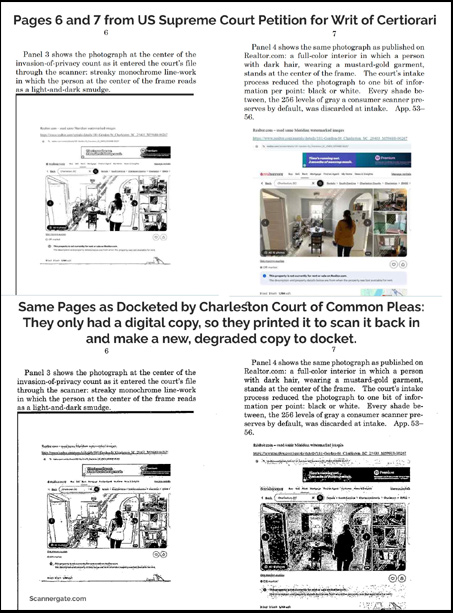 To achieve this unprompted upload, the clerk’s office printed the native digital PDF down to physical paper, then manually fed that paper into an intake scanner set to a primitive black-and-white fax setting (1-bit bitonal scanning). The result is an administrative irony now locked onto the public registry: the court's scanner flattened the document, actively degrading the petition's color evidentiary photographs into unreadable black-and-white smudges on the facing pages. The court literally inflicted the exact technological degradation the SCOTUS petition appeals, using the petition as the medium.
The live, degraded filing is publicly viewable at the Charleston County Public Index Document P1A65 under trial case number 2025CP1005095.
Dismantling the "Administrative Efficiency" Defense
This operational loop completely dismantles the state's traditional defense that restricting electronic filing access for self-represented litigants preserves court efficiency. There is no administrative process more inherently inefficient than receiving a native digital PDF, printing it to physical paper, running it through a manual scanner, and uploading a corrupted, text-unsearchable image file back onto a digital docket. The state infrastructure spent manual labor to deliberately systematically downgrade a file's accuracy.
The ADA Accommodation Illusion
This early docketing loop similarly exposes the bad-faith framework of the court's January 30, 2026, refusal to grant basic Americans with Disabilities Act (ADA) accommodations. The plaintiffs had merely requested remote hearing access upon request - a feature the court already successfully utilized during scheduling conferences—and electronic filing access.
The court's alternative request - allowing the disabled plaintiff to simply email PDF briefs directly to the clerk for manual uploading—was explicitly denied under the guise that it would place an undue operational burden on clerk staff. By proving that the clerk's office possesses the immediate bandwidth to print, hand-scan, and upload a courtesy copy of a massive Supreme Court filing before they were legally required to do so, the court proved that the requested ADA email accommodation could have been seamlessly executed since January.
he Evidence Locker
This institutional trap is completely documented by five irrebuttable pieces of documentary evidence:
More Information on "The Case of the Disappearing Woman"
Turning pro se litigation into a systems study of access to justice for the vulnerable with an innovative system intervention