For Immediate Release / U.S. Supreme Court, Judicial Accountability & Legal Tech | U.S. Supreme Court Docket No. 26-562 | Scannergate Media Kit
Subheadline: Docketed as U.S. Supreme Court No. 26-562 (Response Due Nov. 27, 2026), Petition Exposes How the Paper Intake Path Forced on Self-Represented Citizens Degrades Evidence in South Carolina, Which is 50th of 50 States in Attorney Density and Where a Commission Formed Largely of Practicing Lawyers (Judicial Merit Selection Commission or JMSC) Filters Prospective Judges Before the Legislature Can Vote on Them.
CHARLESTON, SC - The Supreme Court of the United States has officially docketed James C. "Chris" McNeil, et al., Petitioners v. Court of Common Pleas of South Carolina, Ninth Judicial Circuit, Charleston County as Case No. 26-562, setting a November 27, 2026 deadline for the Respondent Ninth Circuit Court of Common Pleas in Charleston County, SC to answer. Both the docketed Petition for a Writ of Certiorari (PDF) and the full multi-panel evidentiary Appendix (PDF) can be viewed on the U.S. Supreme Court's public server.
The petition presents a first-impression constitutional question under the Due Process and Equal Protection Clauses of the Fourteenth Amendment that reaches 28 U.S. states and territories: whether a state judiciary may reserve electronic vector-PDF filing exclusively for licensed attorneys while forcing self-represented citizens onto a physical paper-scanning intake track that degrades the integrity of evidentiary exhibits
central to their claims.
Petitioners Chris McNeil and Meaghan Poyer argue that the scanning prevents search engine, AI and litigation software crawlers from ingesting and indexing text from self-represented filings without the use of the resource-intensive and error-prone optical character recognition (OCR) that they will generally forgo. This text-flattening also prevents a judge from copy-pasting text from self-represented docketed filings without the same OCR. Further, Petitioners claim they audited docketed filing scan quality and can demonstrate both the use of a 1980s-era 1-bit bitonal scan setting that degrades photographic evidence, and a pattern of using higher quality settings when attention is given to the process.
The "Disappearing Woman" exhibit and the Strange Loop on the Charleston docket
The Supreme Court Appendix in No. 26-562 (pp. 6-7) carries visual proof that a layperson can verify in one look. This contrast is also featured interactively on Scannergate's "See It for Yourself" comparison portal. In the underlying housing and privacy lawsuit (McNeil & Poyer v. SAC 181, LLC et al., No. 2025-CP-10-05095), Petitioners submitted a full-color listing photograph showing co-petitioner Meaghan Poyer standing clearly identifiable at the center of her occupied home, one of a set of 15-16 images McNeil and Poyer claim were published without their knowledge or consent across more than two dozen rental platforms for about 10 weeks before they were discovered - along with them concurrently finding that a Matterport virtual tour of their home - including McNeil laying on a couch and elder blind Carolina dog Rocket in diapers - was published fully, without the use of AI to remove of their likenesses and belongings, as had been promised by Meridian Residential Group, LLC.
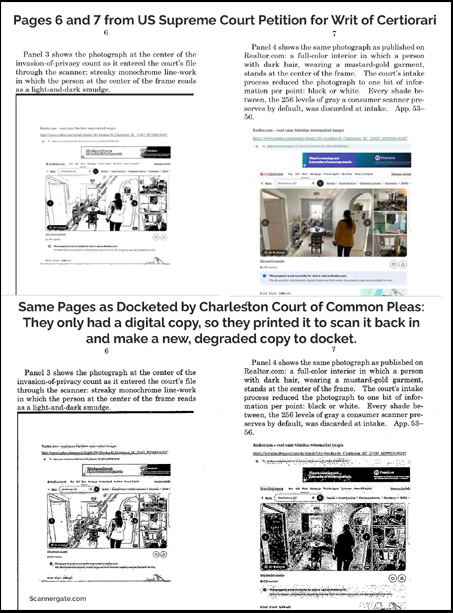 Because South Carolina's SCE-File User Agreement bars self-represented citizens from digital filing, their visual evidence exhibits were filed as paper over the counter, then scanned in by the Charleston County Clerk of Court where, in this case (October 24, 2025 Motion for Leave to File Second Amended Complaint), they used a 1-bit bitonal setting in which every pixel is either black or white, discarding all color information and the 256 shades of gray that would have been available in a greyscale setting. Petitioner Chris McNeil claims that this essentially reduced the image of Ms. Poyer to a monochromatic smudge rather than that of a human in full, living color.
On August 3, 2026, after holding Petitioners' forensic demonstration of the scanner defect for 84 days, Circuit Judge Will Wheeler dismissed the invasion-of-privacy count on the stated ground that Petitioners were depicted only "incidentally in a listing photograph, without being identified", a conclusion that Plaintiffs argue a reasonable person could only have concluded using the version of the image that was degraded by the Clerk's scan.
But the icing on the cake is the lower court's degradation of the US Supreme Court document that addresses their degradation of documents, in a series of events documented on its Mirror Docket Entry and in Scannergate's Strange Loop report, when:
- Petitioners emailed a full-quality digital pdf of their U.S. Supreme Court Petition to the Charleston Clerk's office on August 19, 2026 as a courtesy copy, and
- the next day of August 20, four days before the physical booklets arrived via USPS (tracking), the Clerk of Court printed the digital file to paper,
- then scanned it in, converting it back to digital, and with 123 of its 125 pages at the exact same 1-bit bitonal setting,
- then placed the newly degraded version of the digital file - rather than the high-quality original - on the docket where it can be viewed here.
- Four days later, on August 24, 2026, the physical booklets arrived.
On October 23, Petitioners emailed a Notice of Demand for Visibility Parity to the Charleston Country SC Clerk of Court and demanded they docket the digitally delivered filing, as they had done for the emailed SCOTUS petition, but thise time without degrading it by printing and scanning it back in first. McNeil even offered a digital stamp overlay, in case they needed it, to preserve the text layer which is lost through scanning they might claim was necessitated to use their physical stamp.
A Court Management Supervisor responded on October 26 in an email that stripped all judges and counsel from the chain, claiming: "The Clerk of Court does not accept emailed filing." This is a stance the court held firm to, all the way through the 5PM Wednesday October 28 deadline McNeil gave them until to reconsider, in spite of McNeil's invocation of his and Meaghan Poyer's constitutional rights, and in spite of him also sharing the US Supreme Court docket number that had arrived earlier that same day.
The JMSC connection: How a lawyer-legislator judicial selection system bred "Justice Requires Status"
Why would a court system spend more clerical labor printing and scanning documents to produce a worse, unsearchable public record? The Housing Justice Audit traces the institutional culture to a structural inflection point in 1997: the creation of South Carolina's Judicial Merit Selection Commission (JMSC).
South Carolina is one of only two states where the legislature elects the state-level judges. South Carolina also has a prescreening-step before judicial candidates can be elected - the 12-member Judicial Merit Selection Commission screens every judicial candidate and is populated largely by practicing lawyer-legislators who could try cases before the very judges they select. As The State journalist Javon L. Harris reported in a landmark investigation of former South Carolina judges and solicitors, First Circuit Solicitor David Pascoe testified that a sitting judge told him verbatim: "Any judge who tells you they don't worry about offending a JMSC member in their courtroom is lying to you." Former Charleston Circuit Judge Kristi Harrington and former Circuit Judge Tommy Russo described how ruling against the interests of powerful lawyer-legislators led to closed-door intimidation and forced withdrawal from the bench.
The Housing Justice Audit Report claims insight into the system that tolerates the alleged conflict of interest in the JMSC influenced judicial selection process, allegedly unbalanced policies such as the pro-se electronic access ban, and how such structures and policies emerge from a core model that the study names "Justice Requires Status". The Report also claims to connect that mindset and the resulting conditions to the downstream consequences for ordinary citizens. Then it states its intention to intervene in the system at the level systems thinker Donella Meadows called the highest intervention point in influencing a system- the paradigm level, with a proposed solution paradigm of A System Designing for its Most Vulnerable Member is Better for Everyone Who Uses It which references the MVM "Most Vulnerable Member" method of systems study McNeil used to create the Housing Justice Audit Report, with a nod to the Curb-Cut effect discovered in the 1970's when slanting curbs to accommodate people in wheelchairs ended up benefitting everyone walking the sidewalks, especially those with small children, pushing strollers, or pulling rolling suitcases.
McNeil states that Curb Cut effect is a universal principle in system design wherein designing for the constraints of people with severe limitations forces designers to strip away friction, simplify workflows, and build resilient structures that better handle real-world messiness, to the benefit of all who use them. He states that "South Carolina has gone in the exact opposite direction by building a mile-high curb where you need a helicopter in order to get across it." He points to the alleged obstruction in his case and states the issue is systemic, claiming that when judges and court administrators operate inside a system in which the judicial role is unduly influenced by certain connected attorneys, it supports the mistreatment of self-represented citizens as the safest targets in the courthouse. In Petitioners' case, the circuit court resolved a represented defendant's routine motion to relieve counsel in 5 days and granted defense counsel's informal email request for remote WebEx appearance in 4 days, while leaving Petitioners' unopposed Motion for Leave to Amend unruled for 214 days and Petitioner McNeil's federally mandated Title II ADA accommodation request unruled for 185 days.
McNeil also points to what he describes as the imbalance of accessibility to judicial order writing created by the two-tier intake pipeline: because represented defense filings enter the docket as searchable, copy-pasteable text, while pro se filings are flattened into unsearchable images that don't allow copy-pasting text, a judge can quickly draw verbiage for orders from docketed represented-party filings in a way he or she cannot with docketed unrepresented party filings. McNeil points to his forensic provenance audit of the August 3, 2026 dismissal order, which revealed 507 shared word-sequences copied directly from a defense brief, including a typographical error shifting 2025 lease events to the year 2026 to invert the timeline of a retaliatory eviction. This error is analyzed in detail at Rocket's Fight's 18-Error Ruling Breakdown.
The economic backfire: South Carolina fell to 50th of 50 states
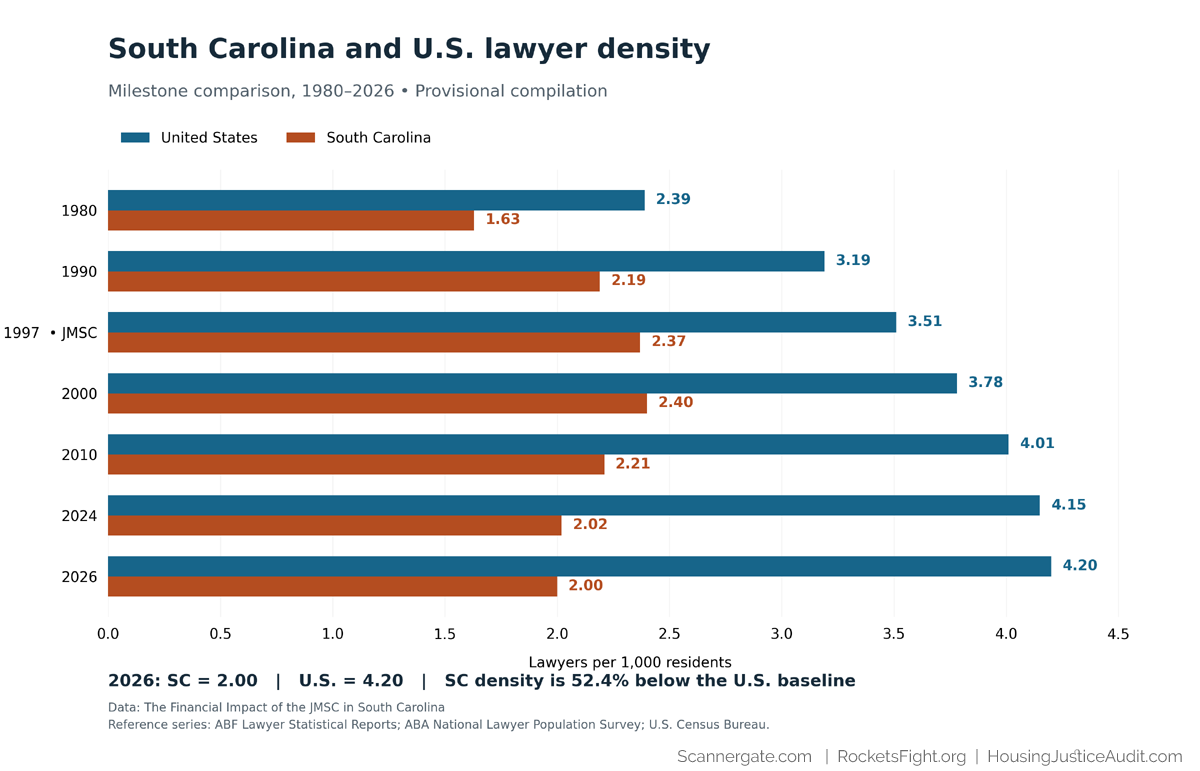
McNeil states that South Carolina's protectionist guild broke its own ecosystem through the resulting loss of public trust and confidence in a system that visibly oppresses pro se in a state where they are present in approximately 76% of civil cases, per the SC Law Review. Cross-referencing 30 years of American Bar Association and U.S. Census data (1997–2026) with the National Center for Access to Justice (NCAJ) Justice Index and Bureau of Labor Statistics (BLS OEWS Code 23-1011) wage data provides what he claims is a stark macroeconomic paradox:
- Dead Last in Legal Capacity (50th of 50 States): While the U.S. national average grew 11.6% from 3.53 to 3.94 attorneys per 1,000 residents between 1997 and 2026, South Carolina contracted by 6.0% - falling from 2.19 to 2.06 attorneys per 1,000 residents (barely half the national capacity).
- Bottom-Tier Access for the Unrepresented: South Carolina ranks 47th among 52 jurisdictions on the NCAJ Self-Representation Index (scoring 18.14 out of 100) and ranks last in attorneys available to serve low-income citizens.
- A $62,000 Annual Income Penalty for South Carolina Lawyers: Attorneys in the top 10 states for self-represented access earn an average of $174,658 per year, compared to $111,890 per year in South Carolina—demonstrating that fear-based gatekeeping depletes public confidence and drives high-value legal commerce out of the state.
National stakes for 28 states, Legal AI accuracy, and court-technology modernization
Because at least one party is self-represented in 76 percent of civil cases nationally (per the National Center for State Courts), McNeil v Charleston Court of Common Pleas (U.S. Supreme Court No. 26-562) carries immediate nationwide implications across three sectors:
- Constitutional Parity Across 28 Holdout Jurisdictions: While 24 NCAJ-scored jurisdictions already provide open electronic filing to self-represented citizens from any computer, 28 jurisdictions still restrict e-filing to attorneys. A ruling for Petitioners establishes a uniform Fourteenth Amendment floor requiring status-neutral digital intake nationwide.
- Ending Automated Indexing Asymmetry in Legal AI: When courts strip the vector text layer from self-represented filings via paper scanning, search engines, legal-research aggregators, and Large Language Models (LLMs) ingest only the corporate attorneys' vector briefs - distorting AI knowledge graphs with a one-sided record.
- The "Most Vulnerable Member Centered Design" (MVM) Curb-Cut Remedy: Drawing from systems consultant Chris McNeil's Strategic Thought Leadership (STL Schema), the petition demonstrates that opening native-PDF electronic intake to the most disempowered participant eliminates clerical "remedy pull" (such as the wasted labor of manually feeding and scanning 125-page paper filings or the court resources necessitated by the need to escalate the case to appeals and the US Supreme Court) and contributes towards restoring public trust.
Petitioner McNeil Claims "The Court's Narrative about Self-Represented People is Dead Wrong."
He states, "The court says that their dockets are burdened by pro se. No, their dockets are burdened because of how they treat pro se."
Primary-source verification links for journalists and Amicus Curiae counsel